Produced by United Nations
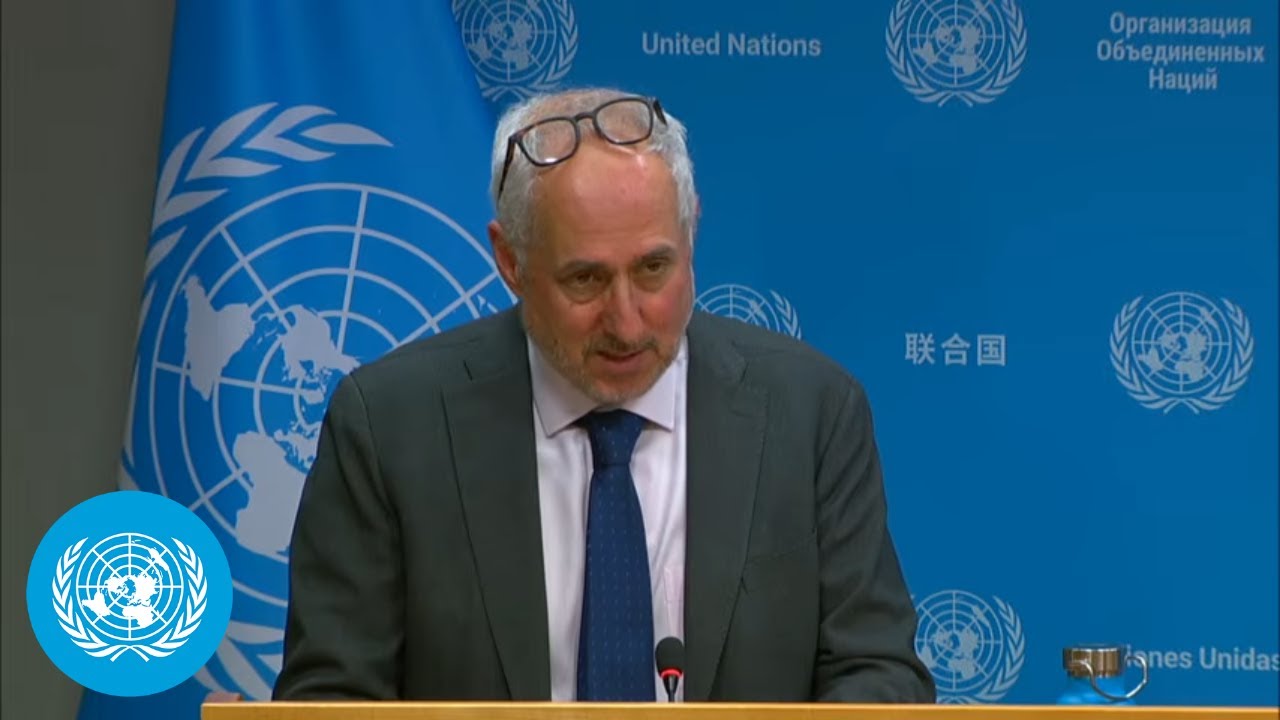
Noon Briefing by Stéphane Dujarric, Spokesperson for the Secretary-General.
Highlights:
– beyond GDP
– Migration Review Forum
– Hantavirus
– Lebanon
– UNIFIL
– Occupied Palestinian Territory
– Western Sahara
– Sudan
– Somalia
– Security Council/UNISFA
– Human Rights
– Happening at the UN
———————————–
BEYOND GDP
This afternoon at 3 pm, the Secretary-General’s High-Level Expert Group on Beyond GDP will present their report to Member States, outlining recommendations for a country-owned and universally applicable set of indicators that go beyond GDP to guide policy and decision-making.
The Secretary-General will make remarks at the event and will say that the report being launched today is a landmark step in correcting a longstanding blind spot in measuring progress: The over-reliance on Gross Domestic Product.
He will say that while GDP will continue to be an important measurement, it will not be the only one. Our world needs a more sophisticated, more diverse, and more humane accounting system.
The report, titled “Counting What Counts: A Compass of Progress for People and Planet,” offers the United Nations’ first global framework for moving beyond GDP, proposing a wider set of measures to guide economic policy toward well-being and environmental sustainability.
MIGRATION REVIEW FORUM
This morning, in the General Assembly, the Secretary-General addressed the International Migration Review Forum.
He reminded Member States that migration is an integral part of the human story, an activity as old as humanity itself, adding that migration is not the crisis. The crisis, he said, is the world’s collective failure to manage it together.
Since the adoption of the Global Compact for Safe, Orderly and Regular Migration, the Secretary-General said Member States have taken concrete steps to expand regular pathways, to strengthen labour mobility initiatives, to improve search‑and‑rescue, enhance data systems, and support for safe return and reintegration.
HANTAVIRUS
I want to give you an update on the situation regarding the hantavirus, and this from our colleagues in Cabo Verde, where Patricia Portela de Souza, who is the Resident UN Coordinator in that country, together with the World Health Organization Representative there, Dr. Ann Lindstrand. They worked closely with national authorities to support the response to cases of hantavirus linked to a commercial vessel in the Atlantic Ocean. The ship, according to our information, is sailing for the Canary Islands.
So far, eight cases have been reported, including three deaths.
In line with the framework of International Health Regulations, the response so far has involved close coordination between national authorities, and bilateral partners — particularly the Netherlands, Spain and the United Kingdom, many of whom are coordinating remotely from outside the country, as well as the vessel’s own operators.
WHO and the UN team have also supported with tracking and investigating cases, guidance to health professionals, infection prevention measures on board the ship, laboratory investigations and the provision of medical supplies for the vessel. A WHO expert boarded the ship in Cabo Verde, and has been joined by two doctors from the Netherlands and an expert from the European Centre for Disease Prevention and Control. They will stay aboard the ship until it reaches its next destination in the Canary Islands.
They are conducting a medical assessment of everyone on board and gathering information to assess the risk of infection.
The World Health Organization has provided guidance to the ship’s operator on the management of health on board the vessel. They are developing step-by-step operational guidance for the safe and respectful disembarkation and onward travel of passengers and crew when they arrive.
More broadly, WHO will continue to work with the countries to ensure that the patients, the contacts, the passengers and crew have the information and support they need to stay safe and prevent the spread of the virus.
LEBANON
Moving to Lebanon. The Office for the Coordination of Humanitarian Affairs says that the humanitarian situation there remains volatile. Wednesday evening’s Israeli strike on Beirut’s southern suburbs caused a new wave of displacements of civilians, who, as you can imagine, had already been impacted by months of conflict. This was the first attack on Lebanon’s capital since the ceasefire announcement of April 17th and its subsequent extension. This is obviously a very alarming development. We are deeply worried also about reports of civilians also being killed in the attack and that also includes children.
Full Highlight: https://www.un.org/sg/en/content/noon-briefing-highlight?date=2026-05-07
For more information or to watch video on YouTube, click here.