2026 International Jazz Day All-Star Global Concert (Chicago, USA) | United Nations

Produced by United Nations

Hier klicken, um den Inhalt von YouTube anzuzeigen.
Learn more in YouTube’s privacy policy.

Renowned musicians from around the world will gather on 30 April in the US city of Chicago for an All-Star Global Concert to mark International Jazz Day. The concert, now in its 15th edition, brings together celebrated artists and audiences to reaffirm the power of jazz in fostering intercultural dialogue, unity and artistic exchange.

The event’s lineup, announced by UNESCO and the Herbie Hancock Institute of Jazz, includes musicians Gregory Porter (United States of America), James Morrison (Australia), Tiger Okoshi (Japan), Mandisi Dyantyis (South Africa), Antonio Sánchez (Mexico), Mino Cinélu (Martinique, France) and many more.

Established by the General Conference of UNESCO in 2011 and recognized by the United Nations General Assembly, International Jazz Day brings together countries and communities worldwide every 30 April. The annual International Jazz Day celebration highlights the power of jazz and its role in promoting peace, dialogue among cultures, diversity and respect for human dignity.

International Jazz Day has become a global movement reaching more than 2 billion people annually on all continents through education programmes, performances, community outreach, radio, television and streaming, along with electronic, print and social media.

More information: https://jazzday.com/

For more information or to watch video on YouTube, click here.
Non-Proliferation of Nuclear Weapons – Press Conference | United Nations

Produced by United Nations

Hier klicken, um den Inhalt von YouTube anzuzeigen.
Learn more in YouTube’s privacy policy.

Press conference by Rafael Mariano Grossi, Director General of the International Atomic Energy Agency, on the Eleventh Review Conference of the Parties to the Treaty on the Non-Proliferation of Nuclear Weapons (NPT).

International Atomic Energy Agency (IAEA) Chief Rafael Mariano Grossi said the Review Conference of the NPT taking place “almost immediately” after the start of a war “that has been predicated on the possibility of one country developing nuclear weapons,” constitutes a challenge because, “there are sides in a war, and people obviously do not see eye to eye.”

Taking questions from journalists in New York as the 11th Review Conference of the Parties to the Treaty on the Non-Proliferation of Nuclear Weapons (NPT) gets underway, Grossi said Iran had declared a new enrichment facility before the June 2025 United States and Israeli coordinated strikes on Iran’s nuclear sites.

He said, “we immediately requested access to it, which was granted, actually. And paradoxically, access was going to take place on June 13th, on the day the attacks commenced. So, we were not in a position to visit this place. So, we could not say at this point whether this place was simply an empty hall, or a place where already cascades and centrifuges were being placed for operation.”

Asked about the possibility of finding consensus on Iran, Grossi said, “in the past, we would have resolutions adopted without a vote at this United Nations Security Council on Iran. Many, several. And then, equally, when the JCPoA was adopted. That common denominator among the membership and in particular the five permanent members of the Security Council is no longer there. It doesn’t mean, and we should strive for that maybe, it doesn’t mean that we cannot reconstruct some degree of consensus around what is happening there. But at the moment, unlike in the past, we don’t have it.”

Asked about the Zaporizhzhia Nuclear Power Plant in Ukraine, he said, “the most important thing at the moment, is to ensure that there is no accident. It’s not an easy task, I can assure you. We are at the moment negotiating the sixth ceasefire. We were able to achieve five already, and the sixth is necessary now to conduct some indispensable repairs on the external power lines that feeds the nuclear power plant there. So, this is our main objective at the moment.”

Asked about Iran’s highly enriched uranium and whether it is still at the Isfahan site, the IAEA Director-General said, “there is no peace. There is only a ceasefire. And there is probably this difficulty in accessing. Until my inspectors can go and verify that there is no access, we cannot confirm that this is the situation. We are being told that this is the case. So, there are lots of things we tried last year with the Cairo Agreement to pave the way for a return of the inspectors there, but of course, with the new war episode this is still delayed.”

Asked about the possibility reviving the Joint Comprehensive Plan of Action” (JCPoA) as a starting point for new negotiations, he said, “Iran in the past few years has had an exponential progress in its program. It has last generation centrifuges, it has different compounds in Esfahan, and we were talking about just new facilities. So, it’s a completely different ball game, as one would say here in America. So JCPoA could not constitute a basis We need to look into something different.”

The NPT Review Conference is being held from 27 April to 22 May 2026 at United Nations Headquarters in New York. The NPT, in force since 1970 and extended indefinitely in 1995, is considered the cornerstone of the global nuclear non-proliferation regime.

For more information or to watch video on YouTube, click here.
Nuclear expansion testing: “It may never be able to be stopped” – Press Conference | United Nations

Produced by United Nations

Hier klicken, um den Inhalt von YouTube anzuzeigen.
Learn more in YouTube’s privacy policy.

Press conference by Robert Floyd, Executive Secretary of the Comprehensive Nuclear-Test-Ban Treaty Organization (CTBTO), on the vital role of the Comprehensive Nuclear-Test-Ban Treaty (CTBT) in advancing the NPT’s (Eleventh Review Conference of the Parties to the Treaty on the Non-Proliferation of Nuclear Weapons) non-proliferation and disarmament objectives.

Floyd addressed the press on the vital role of the Comprehensive Nuclear-Test-Ban Treaty (CTBT) in advancing the non-proliferation and disarmament objectives of the Eleventh Review Conference of the Parties to the Treaty on the Non-Proliferation of Nuclear Weapons (NPT).

He said, “The NPT Review Conference and Nuclear Non-Proliferation Treaty Review Conference here this week, but for the next four weeks, is an important review of the cornerstone of the nuclear nonproliferation and disarmament architecture.”

He said that CTBTO “is about implementing a treaty that sits within that architecture, and that is a treaty, the Comprehensive Nuclear Test Ban Treaty, banning nuclear explosions of any size – from the tiniest to the largest. That is an essential part of being able to stop the spread of nuclear weapons around the world from state to state, and also to limit the further development of nuclear weapons.”

He continued, “The Treaty has not yet entered into force, and therefore is not legally binding, but our international monitoring system will detect a nuclear weapon explosion of 500 tons of TNT or above, anywhere across the face of the planet, or underwater, underground, it will be detected. And that is a powerful benefit to all humanity, because any state that thinks of developing a nuclear weapon would need to test one, and if they did, it will be known to all.”

He highlighted, “In the current situation, the CTBT and the ban on testing is a little bit more in front of mind than what it has been for a long time, particularly when states are threatening to return to testing and the likelihood that if one state tests, others would and even more would potentially then go into a spiral of expanded testing. That is a spiral that we do not want to see start, because it may never be able to be stopped.”

He reported, “We have 187 states have signed. 178 have ratified. But there are nine specific ones that still need to ratify so the treaty could become legally binding. That is an important issue.”

Answering a question, he said, “We need to see a way that the United States of America, the Russian Federation, the People’s Republic of China, might be able to address the treaty and its ratification together. It is, I think, quite unlikely that any one of them would move on that without the others simultaneously moving together. And that certainly is something that I would encourage all of those states to consider, and that would certainly be a powerful step forward.”

For more information or to watch video on YouTube, click here.
Two nurses. Four generations. One belief — that every child deserves to grow up protected.

Produced by United Nations

Hier klicken, um den Inhalt von YouTube anzuzeigen.
Learn more in YouTube’s privacy policy.

This World Immunization Week, a family shares what they’ve seen, what they’ve carried, and why vaccines matter across every generation.

For every generation, vaccines work.
#WHО

For more information or to watch video on YouTube, click here.
Lebanon, UNIFIL, West Bank & other topics – Daily Press Briefing (29 April 2026) | United Nations

Produced by United Nations

Hier klicken, um den Inhalt von YouTube anzuzeigen.
Learn more in YouTube’s privacy policy.

Noon briefing by Stéphane Dujarric, Spokesperson for the Secretary-General.

Highlights:
Deputy Secretary-General
Lebanon
UNIFIL
Occupied Palestinian Territory
West Bank
Iran
Yemen
Somalia
Sudan
South Sudan
Democratic Republic of the Congo/Peacekeeping
Democratic Republic of the Congo/Humanitarian
Information integrity
Victim’s Rights Advocate Report
Climate/Europe
International Day

DEPUTY SECRETARY-GENERAL

The Deputy Secretary-General is back in New York City, following her recent visits to Australia and Singapore earlier this week, in which she engaged with government leaders, civil society, the private sector, media, youth on advancing gender equality, multilateral cooperation and responses to global challenges.

In Singapore yesterday, the Deputy Secretary-General paid a courtesy call on the country’s President, Tharman Shanmugaratnam, and exchanged views on key international developments, UN80 reforms and Singapore’s leading role on artificial intelligence and new technology. She thanked the President for Singapore’s strong support for the United Nations and multilateral cooperation.

Prior to that, during a visit to Melbourne, the Deputy Secretary-General delivered the keynote address at the Opening Plenary of the Women Deliver 2026 Conference, underscoring that women’s rights are human rights and warned of a global rollback on gender equality amid conflict, climate shocks, shrinking resources and growing pushback against women’s autonomy.

LEBANON

The Office for the Coordination of Humanitarian Affairs tells us that the situation in Lebanon continues to be fragile and volatile given the insecurity, especially in the southern part of Lebanon. Lebanese authorities reported that three civil defence rescue workers were killed in the southern part of the country when two strikes hit a building in Tyre District. That took place yesterday. Authorities said the emergency teams were responding to people wounded in an earlier strike at the same place.

The incident underscores the risks faced by civilians, including emergency and humanitarian workers. According to the World Health Organization, since the start of the conflict, the number of attacks on healthcare has climbed to 149, with 100 deaths and 233 injured. Attacks on civilians and civilian infrastructure, and health workers are not only unacceptable, they are against international humanitarian law, as we keep saying.

All parties in this conflict have to observe their obligations under these laws.

Today, Israeli authorities issued a new displacement order south of the Litani River, covering 16 areas and instructing residents to move to the nearby town of Saida.

Women and children remain disproportionately affected. There are reports they are facing increased psychological distress and are bearing the brunt of the impacts of displacement, family separation, and economic hardship. Risks of gender-based violence remain high, particularly in overcrowded shelters.

We and our partners are responding to the mounting needs where access allows.

Compounding the situation, today our colleagues at the Food and Agriculture Organization and the World Food Programme warned that the sharp escalation in violence has reversed recent food security gains and pushed the country back into crisis. This is what the latest Integrated Food Security Phase Classification (IPC) for Lebanon tells us.

The projected analysis reveals that 1.24 million people, that’s nearly one in four of the population that was looked at, are expected to face food insecurity levels classified as Crisis or IPC Phase 3 or worse, between April and August of this year. IPC 3 means that people start skipping meals or start selling some of their [possessions] in order to buy food.

But despite these growing needs, the humanitarian response remains significantly underfunded. The Lebanon Flash Appeal has received just over $117 million, which is only 38 per cent of the money that we need, which is $308 million.

Full Highlights: https://www.un.org/sg/en/content/noon-briefing-highlight?date=2026-04-29

For more information or to watch video on YouTube, click here.
Not My Words: The Actor Who Carries the Voice of Genocide | United Nations

Produced by United Nations

Hier klicken, um den Inhalt von YouTube anzuzeigen.
Learn more in YouTube’s privacy policy.

The 1994 Genocide against the Tutsi in Rwanda remains one of the darkest chapters in human history. In just one hundred days, more than one million women, men, and children were murdered—overwhelmingly Tutsi. Long before the killing began, a wave of propaganda flooded the airwaves, spreading fear, normalizing hate, and stripping people of their humanity. Words came first—and words helped make the violence possible.

Diogène Ntarindwa, known by his stage name Atome, is a Rwandan playwright and comedian whose life has been shaped by this history. Born in Burundi to Rwandan parents who fled earlier massacres of the Tutsi, he later joined the Rwandan Patriotic Front and entered Kigali in 1994 while the genocide was still underway. He describes himself not as a survivor, but as a witness.

In Hate Radio, directed by Milo Rau and presented in its U.S. premiere at St. Ann’s Warehouse in February 2026, Diogène performs the role of Kantano, a real-life broadcaster for Radio Télévision Libre des Mille Collines (RTLM). The play places audiences inside the RTLM studio—often called “Radio Machete”—where hate speech was delivered through jokes, music, and chilling everyday banter.

RTLM played a critical role in inciting violence; its co-founder was later convicted by the UN International Criminal Tribunal for Rwanda. For Diogène, performing Hate Radio is an act of testimony. After more than 250 performances, carrying these words ensures their danger is never forgotten—and never repeated.

At UN Headquarters, Diogène sits with the Special Advisor on the Prevention of Genocide to discuss how language escalates from insult to incitement — and visits the “Kwibuka Flame of Hope,” a permanent memorial installed at UN Headquarters in New York in 2024 as a gift from Rwanda. It stands as a tribute to the victims and survivors of the 1994 Genocide against the Tutsi and as a reminder of our shared responsibility to confront hate before it takes root.

In recognition of 7 April 1994, the start of the genocide, this date is observed each year as the International Day of Reflection on the 1994 Genocide against the Tutsi in Rwanda.

In 2004, the United Nations established the Office of the Special Adviser on the Prevention of Genocide, on the basis of the lessons learned from the failures of prevention in Rwanda in 1994 and Srebrenica in 1995, to provide early warning, analysis, and advice to the Secretary‑General on prevention of genocide and other atrocity crimes.

LEARN MORE:
🔗 Outreach Programme on the 1994 Genocide against the Tutsi in Rwanda: https://www.un.org/en/preventgenocide…
🔗 Office of the Special Adviser on the Prevention of Genocide: https://www.un.org/en/genocide-preven…
🔗 International Day of Reflection: https://www.un.org/en/preventgenocide…
🔗 Kwibuka Flame of Hope: https://www.un.org/en/preventgenocide…
🔗 United Nations Audiovisual Library: https://media.un.org/avlibrary/en

0:00 — The Radio Broadcasts That Incited Genocide in Rwanda
0:29 — The 1994 Genocide Against the Tutsi: What Happened
0:56 — St Ann’s Warehouse: The Post-It That Waited 10 Years
1:35 — Diogène Ntarindwa: The Actor Who Was a Witness
2:25 — How Repetition and Propaganda Normalize Hate Speech
3:47 — From Incitement to Prevention: A Conversation at the United Nations 5:01 — The Kwibuka Flame: Rwanda’s Memorial at the United Nations

For more information or to watch video on YouTube, click here.

South Sudan Integrated Food Security Phase Classification Report – Press Conference | United Nations

Produced by United Nations

Hier klicken, um den Inhalt von YouTube anzuzeigen.
Learn more in YouTube’s privacy policy.

Hunger intensifies in South Sudan as 7.8 million people face high acute food insecurity and 2.2 million children suffer acute malnutrition, UN Agencies warned.

The Food and Agriculture Organization (FAO), the World Food Programme (WFP) and UNICEF today warned that a deepening hunger crisis in South Sudan is pushing 7.8 million people into high levels of acute food insecurity (IPC Phase 3 or above) between April and July 2026, according to the latest Integrated Food Security Phase Classification (IPC) analysis. This represents 56 percent of the population—one of the highest levels of acute food insecurity in the world today.

Among those projected to be acutely food insecure, 73,300 people are facing Catastrophe (IPC Phase 5), the most severe level of acute food insecurity. This represents a dramatic increase of 160 per cent from the last estimate. Meanwhile, 2.5 million people are in Emergency (IPC Phase 4) and 5.3 million in Crisis (IPC Phase 3).

The crisis is being driven by escalating conflict, mass displacement, economic decline, climate shocks, flooding, and below-capacity agricultural production, all of which are reducing food availability and limiting families’ access to enough food. In Jonglei alone, nearly 300,000 people have been displaced, leaving many communities cut off from humanitarian assistance, while rising food prices, disrupted markets, and weak household purchasing power are further deepening food insecurity.

At the same time, acute malnutrition is being exacerbated by lack of access to health and nutrition services where facilities have been damaged or closed due to conflict. In addition, the shortages of supplies and funding have reduced access to life-saving treatment. Disease outbreaks, including cholera, malaria, and measles, are compounding the crisis, particularly among vulnerable and already acutely malnourished children.

The agencies warn of a credible risk of famine in four counties across Upper Nile and Jonglei states. Conflict-affected communities have been cut off from food, markets, and essential services, under a worst-case scenario of escalating conflict, further displacement, and constrained humanitarian access. The IPC projects 11 counties across Upper Nile, Unity, and Jonglei states to face IPC Acute Malnutrition Phase 5 (Extremely Critical) outcomes. Humanitarian assistance is being scaled up in some areas, but coverage remains uneven, with some communities still inaccessible and receiving little or no support.

For children, the nutrition situation has continued to worsen. Currently, 2.2 million children aged 6 months to five years old are suffering from acute malnutrition, an increase of 100,000 cases when compared to six months ago. Through July this year, 700,000 children are projected to face severe acute malnutrition, the deadliest form. Similarly, 1.2 million pregnant and breastfeeding women are acutely malnourished, placing both mothers and infants at heightened risk.

At the same time, flooding and below-capacity agricultural production are further undermining food availability.

FAO, WFP and UNICEF – along with the Nutrition and WASH clusters – are calling on the international community and governments to act immediately. Sustained funding for food assistance, nutrition programmes, clean water and sanitation, and health services are critical to prevent further deterioration.

Parties to the conflict must ensure safe, rapid, and unfettered humanitarian access to all affected areas must be guaranteed without delay. Sustained funding for food assistance, nutrition programmes, clean water and sanitation, and health services is critical to prevent further deterioration. The agencies are also urging all parties to the conflict to protect civilians and enable the delivery of life-saving assistance. Without rapid, large-scale intervention, the people of South Sudan risk facing an irreversible humanitarian catastrophe.

For more information or to watch video on YouTube, click here.
Middle East: Situation in Gaza & West Bank steadily worsening – Briefing | United Nations

Produced by United Nations

Hier klicken, um den Inhalt von YouTube anzuzeigen.
Learn more in YouTube’s privacy policy.

Briefing by Khaled Khiari, Assistant Secretary-General for the Middle East, Europe, the Americas, Asia and the Pacific in the Departments of Political and Peacebuilding Affairs and Peace Operations, on the situation in the Middle East.

Khiari said, “the tension and hostilities that have happened at the Middle East over the past weeks have shifted the tension from the situation in the Occupied Palestinian Territory,” but, “away from the spotlight, the situation in Gaza and the West Bank, including East Jerusalem, is steadily worsening.”

He said, “the population in Gaza faces ongoing and deadly Israeli strikes and dire humanitarian conditions, while in the West Bank, violence, including rampant settler violence, displacement and accelerating settlement activity are threatening entire communities and further eroding the prospects for a political process that will resolve the conflict on the basis of a viable two-state solution.”

Khiari said, “civilians continue to bear the brunt of the ongoing violence” and noted that since the ceasefire began, “approximately 800 Palestinians, including more than 200 children and seven humanitarian personnel have been killed as a result of Israeli strikes, shelling and gunfire,” while “humanitarian needs on the ground remain overwhelming.”

In the West Bank, the Assistant Secretary-General said, “the frequency and severity of settler attacks continue to increase” as “entire Palestinian communities, now routinely facing lethal violence, vandalism and harassment, often in the presence of Israeli soldiers or with their participation.”

In Lebanon, he said, “six peacekeepers, four Indonesians and two friends serving with the entry force in Lebanon have been killed since the 2nd of March, with several more injured.”

Khiari said, “resolving the Israeli-Palestinian conflict remains central to achieving durable peace in the region, as it continues to fuel instability across the Middle East,” adding that the meetings of the Global Alliance for the implementation of the Two-State Solution and the AD Hoc Liaison Committee (AHLC) on 20 April “underscored the ongoing commitment of the international community to preserving what has been built over the past decades, identifying and reversing the deeply destructive current trends on the ground, and finding ways to translate political will into concrete policy steps on the ground, backed by financial commitments.”

For more information or to watch video on YouTube, click here.
UN Movie Society: Featuring AGON – Month of the International Day of Sport for Development and Peace

Produced by United Nations

Hier klicken, um den Inhalt von YouTube anzuzeigen.
Learn more in YouTube’s privacy policy.

On 30 April 2026, in observance of the month of the UN International Day of Sport for Development and Peace, the UN Movie Society of the United Nations Staff Recreation Council is honoured to present a special conversation with filmmaker Giulio Bertelli, director of the award-winning film AGON.

AGON is a powerful film set against the fictional Olympic Games of Ludoj 2024, following three women athletes competing in rifle shooting, fencing, and judo. Winner of two awards at Venice International Film Festival’s Critics’ Week, the film draws on the historical archetype of Joan of Arc, Cleopatra, and Nadezhda Durova, to explore the political, physical, and technological pressures at the highest levels of sport—where human endurance meets machine precision, and where the ancient Greek concept of agōn—struggle, competition, conflict—finds its most vivid expression.

The International Day of Sport for Development and Peace reminds us that sport is a universal language that transcends borders, fosters solidarity, and serves as a catalyst for human dignity, gender equality, and sustainable peace. Through AGON, the UN Movie Society shows how the film champions the values of the United Nations Charter—peace, gender equality, and cultural appreciation—demonstrating the unique power of cinema to promote these global ideals. Founded at the United Nations Headquarters by Brenda Vongova, the UN Movie Society is committed to championing the goals and values of the United Nations through the universal language of motion pictures.

For more information or to watch video on YouTube, click here.
40 years after the #Chornobyl disaster, the world remembers

Produced by United Nations

Hier klicken, um den Inhalt von YouTube anzuzeigen.
Learn more in YouTube’s privacy policy.

Forty years ago, an explosion at the Chernobyl Nuclear Power Plant spread a radioactive cloud over large parts of the Soviet Union, now the territories of Belarus, Ukraine and the Russian Federation, exposing nearly 8.4 million people there to the radiation. Commemorating the tragic milestone, United Nations General Assembly President Annalena Baerbock calls for measures to prevent future accidents.

For more information or to watch video on YouTube, click here.
Strait of Hormuz, Middle East & other topics – Daily Press Briefing (27 April 2026) | United Nations

Produced by United Nations

Hier klicken, um den Inhalt von YouTube anzuzeigen.
Learn more in YouTube’s privacy policy.

Noon Briefing by Stéphane Dujarric, Spokesperson for the Secretary-General.

Highlights:
– Strait of Hormuz
– Middle East
– Security Council
– Occupied Palestinian Territory
– Lebanon
– Syria
– Somalia
– Somalia/World Food Programme
– Sudan
– Afghanistan/Women and Girls
– Afghanistan
– Senior Personnel Appointment/UNAMA
– Jamaica
– Climate
– South Africa
– Trip Announcement
– South Sudan
– Hepatitis
– International Day
– Financial Contributions

STRAIT OF HORMUZ

The UN Trade and Development, or UNCTAD for short, has come up with an online dashboard to track shipping, food and energy prices, as well as financial markets, related to the Strait of Hormuz restrictions.
For instance, today, the dashboard says that ship transits related to the Strait of Hormuz have decreased by 95.3 percent since 28 February, while commodity food prices have risen by 6 percent and the crude oil price for Europe has risen by 53 percent since then. https://unctad.org/strait-of-hormuz-dashboard.

MIDDLE EAST

The Secretary-General’s Personal Envoy for the Middle East Crisis and its Consequences, Jean Arnault, is consulting with senior UN officials following his visits to Iran, Saudi Arabia, Oman, and Egypt. He also participated in the annual Antalya Diplomatic Forum in Türkiye. The Personal Envoy will continue to engage relevant Member States at Headquarters and in capitals as he works to support efforts aimed at helping the warring parties reach a comprehensive settlement.
During his visits to regional capitals, the Personal Envoy received first-hand briefings and personally witnessed the impact of the five-week armed escalation on civilians and civilian infrastructure across the region, following the United States–Israeli attack on Iran on 28 February 2026 and the subsequent Iranian attacks in the region.
The Personal Envoy remains available to support all efforts to assist the warring parties in moving towards a comprehensive settlement, including the initiative currently being pursued by the Government of Pakistan in cooperation with the Governments of Egypt, Saudi Arabia, and Türkiye.

SECURITY COUNCIL

Khaled Khiari, Assistant Secretary-General for the Middle East, Europe, the Americas, Asia and the Pacific, briefed the Security Council on the Middle East this morning and said that, away from the spotlight, the situation in Gaza and the West Bank, including East Jerusalem, is steadily worsening.
He said that the population in Gaza faces ongoing and deadly Israeli strikes and dire humanitarian conditions, while in the West Bank, violence including rampant settler violence, displacement, and accelerating settlement activity are threatening entire communities and further eroding the prospects for a political process that will resolve the conflict on the basis of a viable two-State solution.

Full Highlights: https://www.un.org/sg/en/content/noon-briefing-highlight?date=2026-04-28

For more information or to watch video on YouTube, click here.
Safety and Protection of Waterways in the Maritime Domain – UN Chief’s Briefing | United Nations

Produced by United Nations

Hier klicken, um den Inhalt von YouTube anzuzeigen.
Learn more in YouTube’s privacy policy.

UN Secretary-General António Guterres urged Member States to support the emergency evacuation framework prepared by the International Maritime Organization (IOM) to securely evacuate ships and seafarers from the conflict zone.

Addressing the Security Council about ‘Safety and Protection of Waterways in the Maritime Domain’, Guterres said, “Safe, unimpeded passage is an economic and humanitarian imperative. The economic shock has been immediate – and everyone is paying the price.”

He highlighted, “Behind the cargo figures and the price surges are people. More than 20,000 seafarers remain stranded at sea. Over 2,000 commercial vessels are caught in a web of risks and restrictions to navigation. These men and women are not parties to any conflict. They are civilian workers keeping the world supplied. Their safety, their well-being, and their rights must be protected – at all times, and in all waters.”

He urged Member States to support the emergency evacuation framework prepared by the International Maritime Organization, “A coordinated plan to ensure the safe movement, assistance, and protection of affected crews in full accordance with international law.”

He continued, “The Charter’s prohibition of the threat or use of force applies fully at sea. Navigational rights and freedoms through the Strait of Hormuz must be respected – as affirmed by this Council’s Resolution 2817. These principles must be upheld – in full, and without delay. I appeal to the parties: Open the Strait. Let ships pass. No tolls. No discrimination. Let trade resume. Let the global economy breathe.”

For more information or to watch video on YouTube, click here.
Non-Proliferation of Nuclear Weapons: The most challenging time – Press Conference | United Nations

Produced by United Nations

Hier klicken, um den Inhalt von YouTube anzuzeigen.
Learn more in YouTube’s privacy policy.

The President of the NPT Review Conference, Viet Nam’s Ambassador Do Hung Viet, told journalists in New York that the danger of a nuclear war is “seen and is felt, I think, much more concretely these days” and said that without an outcome document from the Conference “I would not say it would be a success.”

As the 11th Review Conference of the Parties to the Treaty on the Non-Proliferation of Nuclear Weapons (NPT) got underway, Do said it is convening “at a particularly challenging time,” and “the most challenging time for the NPT regime itself.”

Asked about Iran’s election as a conference’s vice-presidency, he said the nomination had been made “a few months ago, but the concern about Iran’s candidacy on emerged about a week ago,” and noted that it is “the right of any state party and the right of any group to nominate their candidates.”

The Ambassador said, “what we have managed to do is to get the agreement of all the states parties that instead of asking for a vote, they would instead disassociate themselves from the decision made at the conference. So, again, this is an issue that only came out about a week ago. So, it is not reflective of the consultations that I have had over the past eight months.”

Asked about Israel status as a non-member of the NPT, he said “there are continuous” calls for Israel, India, and Pakistan “to join the NPT as non-nuclear weapon states.”

Responding to a question on what would constitute a success, Do said, “if the conference is conducted smoothly, in an inclusive manner, where everyone is heard, everyone’s view can be reflected. I think that is also, it can be characterized as a good conference. But again, I would not say it would be a success.”

The Ambassador said, “nuclear rhetoric and arms race, nuclear arms race, is really looming. The threat to use nuclear weapons have been floating up there. The modernization and expansion of nuclear arsenals and the violation of international law, the level of mistrust amongst major powers and regional countries. So, the stakes are very, very high, actually.”

The 11th Review Conference of the Parties to the Treaty on the Non-Proliferation of Nuclear Weapons (NPT) is being held from 27 April to 22 May 2026 at United Nations Headquarters in New York

The NPT, in force since 1970 and extended indefinitely in 1995, is considered the cornerstone of the global nuclear non-proliferation regime.

For more information or to watch video on YouTube, click here.
Non-Proliferation of Nuclear Weapons: UN Chief’s Briefing | United Nations

Produced by United Nations

Hier klicken, um den Inhalt von YouTube anzuzeigen.
Learn more in YouTube’s privacy policy.

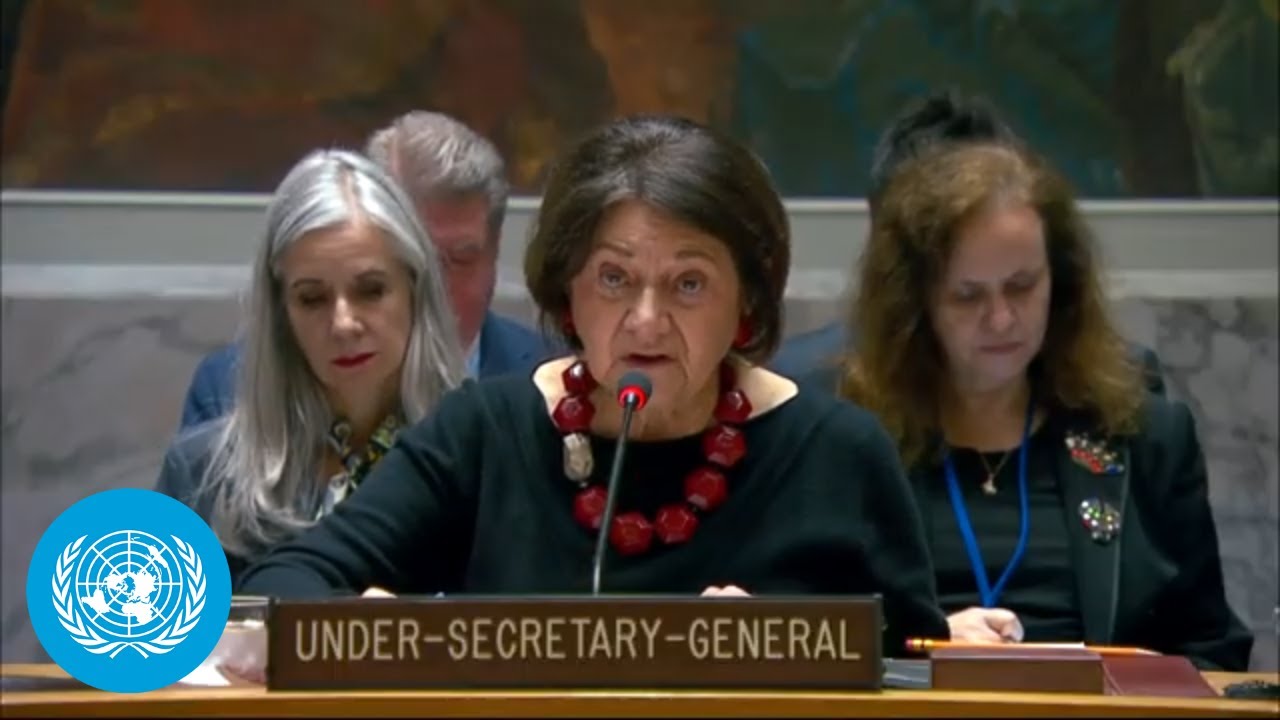
“Have we forgotten that a nuclear war cannot be won and must not be fought?” United Nations Secretary-General António Guterres said, as the Nuclear Non-Proliferation Treaty review conference opened.

Opening the NPT Review Conference at UN Headquarters in New York today (27 April 2026), Secretary-General António Guterres said, “Global military spending soared to 2.7 trillion dollars last year, thirteen times more than all development aid globally, and equivalent to the entire Gross Domestic Product of Africa. For the first time in decades, the number of nuclear warheads is on the rise. Nuclear testing is back on the table. Some governments are openly mulling the acquisition of these horrific weapons. Have we forgotten that a nuclear war cannot be won and must not be fought? Have we forgotten that nuclear weapons make no one safer? Have we forgotten that the only reason the world did not tumble into the abyss was because leaders stood together and said: enough?”

Guterres added, “As you begin your deliberations today, I urge you to focus on two key points. First, countries must keep their promises under the Treaty. Without caveats. Without conditions. Without delays. Without excuses. It is time to re-commit to disarmament and non-proliferation as the only true path to peace.”

He concluded: “The Treaty is not a relic of a former age, frozen in amber. It must grapple with the nexus between nuclear weapons and new technologies. It must ensure that, until nuclear weapons are eliminated, humanity never cedes control over their use. And it must help expand access to the benefits of nuclear science and technology for sustainable development.”

Vietnam’s Permanent Representative Đỗ Hùng Việt, who presides over the conference, said, “For more than half a century, the NPT has played a vital role in curbing the spread of nuclear weapons, advancing nuclear disarmament and promoting the peaceful uses of nuclear energy. As a crucial part of the NPT regime review conferences have served as our points of reference on both where we stand and where we must go. They have guided our collective path toward the aspiration of a world free of nuclear weapons.”

Việt added, “This is not just another review conference. The success or failure of this conference will have implications way beyond these halls and way beyond these next five years. The prospects of a new nuclear arms race are looming over us, the scale of which we are yet to fathom. The prospects of a world without an effective functioning NPT regime would, in all likelihood, be one where regional rivalries increasingly have nuclear dimensions, where the taboo against nuclear use erodes further, and where collective security is diminished by the potential spread of nuclear weapons.”

The United States, United Kingdom, France, Germany, UAE, and Australia all objected to Iran serving position as Vice-President of the General Committee, though none called for a vote, citing a desire not to disrupt the conference’s work. Iran retained the position.

The United States representative said, “Indeed, it is an affront to the NPT itself that a country that has so blatantly disregarded its obligations under the treaty should take a place of honor and responsibility as a Vice President on the General Committee that should help coordinate our work over the next four weeks. Our commission is to strengthen the treaty and affirm its commitments. But choosing to open this review conference by conferring leadership on a country that is notoriously violating the very treaty it has pledged to uphold, is an affront to countries that treat the NPT commitments seriously.”

Iran’s representative said, “It is a matter of regret that at the beginning of the conference, we witnessed some political statements. Rather than being ready to engage in a substantive discussion on issues very important to all humanity’s especially nuclear disarmament. My delegation rejects categorically and in the strongest possible term, the statement just delivered by the United States. The allegation put forward are baseless and politically motivated, devoid of any credibility. They constitute a deliberate attempt to mislead this conference and to manipulate its procedure for narrow and self-serving purposes.”

For more information or to watch video on YouTube, click here.
Iran on disruption to maritime transport – Security Council Stakeout | United Nations

Produced by United Nations

Hier klicken, um den Inhalt von YouTube anzuzeigen.
Learn more in YouTube’s privacy policy.

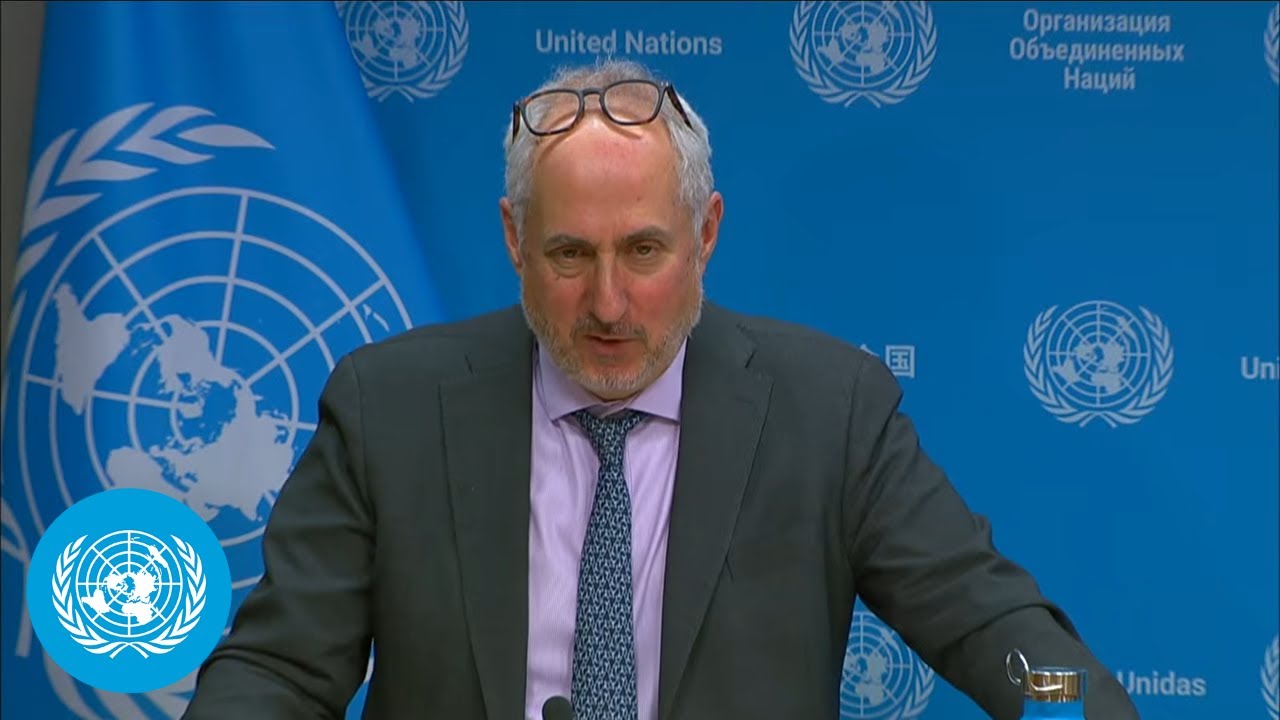
Iranian Ambassador Amir Saeid Iravani said that the “responsibility for any disruption to maritime transport lies with the aggressors: the United States and its supporters. Any claim to the contrary is unfounded.”

Addressing the press after the Security Council meeting on about ‘Safety and Protection of Waterways in the Maritime Domain,’ Amir Saeid Iravani, Permanent Representative of the Islamic Republic of Iran, said “In constraint, Iran’s measures in the state of Hormuz was grounded in Iran’s right and obligation under the law of the sea and its national laws and regulations. Iran’s lawful measures aim to strike an appropriate balance between security interests of the coastal state and the continuous safe conduct of navigation in the Strait of Hormuz in a high volatile environment.”

He added, “These practical measures will be carefully examined in light of evolving circumstances. Iran is not a party to the 1982 UN Convention on the Law of the Sea. Accordingly, it is not bound by its treaty-based provisions, except to the extent that specific rules reflected therein are universally recognized as customary international law.”

For more information or to watch video on YouTube, click here.