Produced by United Nations
Bahrain together with the United States, with the backing of Kuwait, Qatar, Saudi Arabia and the United Arab Emirates, circulated a draft resolution earlier this week to the Security Council on the situation of Strait of Hormuz. It calls on Iran to cease attacks, mining, and tolling in the Strait as well as to participate in the UN’s efforts to establish a humanitarian corridor.
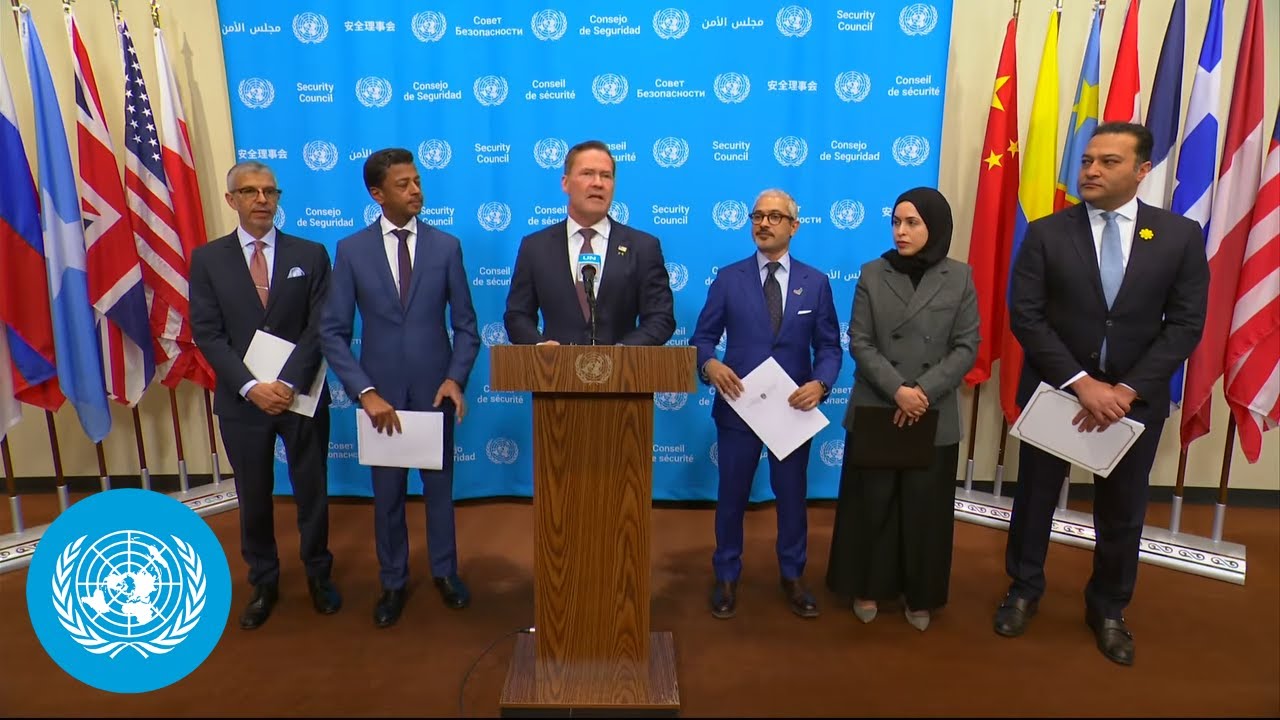
Speaking to reporters today (7 May) in New York, Bahrain’s Ambassador Jamal Fares Alrowaiei said, “the draft resolution is guided by the clear principal – freedom of navigation in accordance with the international law, as reflected in the United Nations Convention on the Law of the Sea.:”
Ambassador Alrowaiei emphasized that it also supports ongoing efforts to seek durable peace in the region and encourages dialog in the regard. “This initiative reflects our strong commitment to regional security, to multilateral cooperation, and to the peaceful resolution of dispute,” he said.
US Ambassador Mike Waltz pointed out that the draft revolution is “an evolution “of resolution 2817. It “requires Iran to do some very simple, straightforward things, the Ambassador said, “cease its attacks on commercial shipping, cease mining and remove its mines from an international waterway; cease tolling, charging illegal tolls in the Strait of Hormuz, and allow the UN to move forward with humanitarian aid, lifesaving aid, through that international corridor.”
The US Ambassador stated that now it is left for the international community to choose, “are the countries of the Council choosing to stand with a regime that slaughters its own people, that brutalize its neighbors, that strangles the world’s economy? Or are they standing with the shining cities of Manama, Kuwait City, Dubai, Riyadh, Doha with the people that seek a better future for not only their people, but for the region and for the world?”
“I know what decision the United States is making,” Ambassador Waltz reiterated, “we’re choosing to stand with the freedom of navigation. We’re choosing to stand with international law. We’re choosing to stand with our partners as we move forward.”
For his part, Ambassador of the United Arab Emirates Mohamed Abushahab said, “while the draft resolution does not give any authorization or impose sanctions on Iran, by acting under Chapter VII, the Council would make clear that its decisions in this resolution are binding and that the Council is serious about them, and that it may consider further measures if its decisions are not implemented.”
Ambassador of Qatar Alya Ahmed bin Saif Al-Thani said, “we look forward to continuing our engagement intensively with Member States to secure the support for this timely Security Council resolution on guaranteeing the freedom of navigation while protecting maritime waterways.”
The Ambassadors at the press encounters are US Ambassador Mike Waltz, Ambassador Jamal Fares Alrowaiei, Bahrain’s Permanent Representative to the United Nations, Ambassador Mohamed Issa Abushahab, UAE’s Permanent Representative to the United Nations, Ambassador Abdulaziz M. Alwasil, Saudi Arabia’s Permanent Representative to the United Nations, Ambassador Alya Ahmed Saif Al-Thani, Qatar’s Permanent Representative to the United Nations, and Ambassador Tareq M. A. M. Albanai, Kuwait’s Permanent Representative to the United Nations.
For more information or to watch video on YouTube, click here.