Produced by United Nations
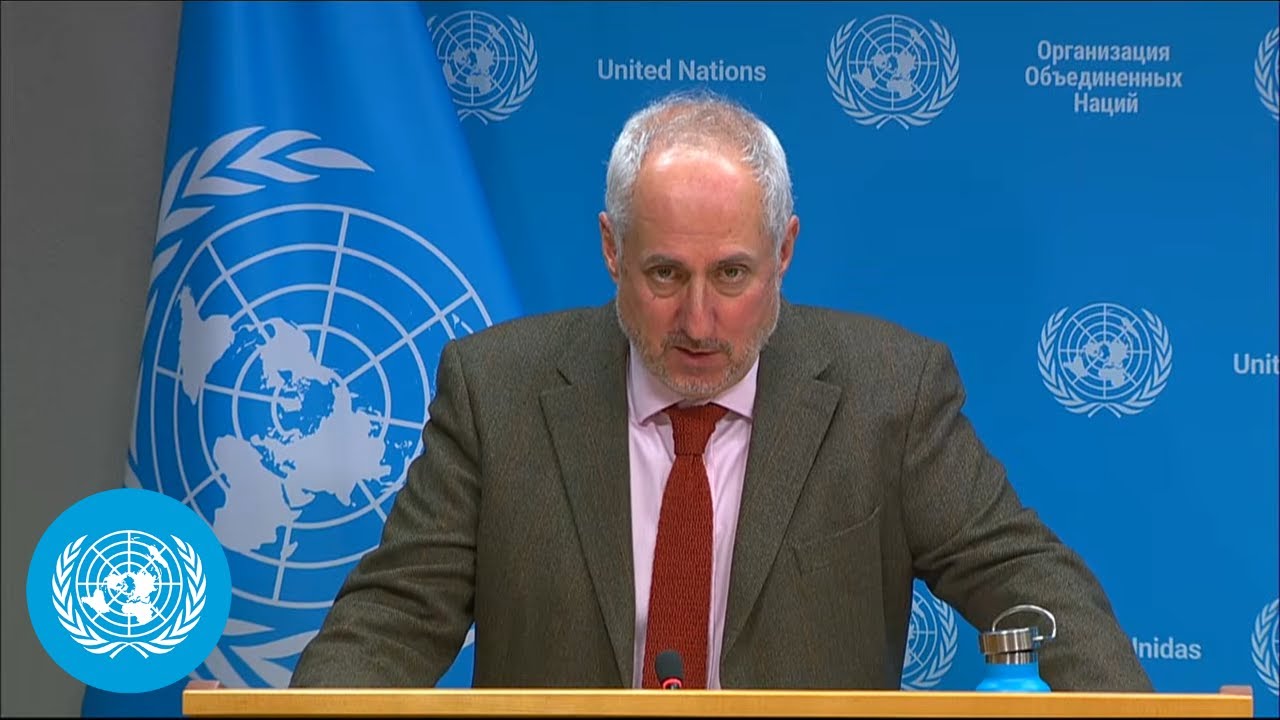
Noon Briefing by Stéphane Dujarric, Spokesperson for the Secretary-General.
Highlights:
Non-Proliferation of Nuclear Weapons
Security Council
Lebanon/Israel
Lebanon/Humanitarian
Occupied Palestinian Territory
Syria
Mali
Mali/Humanitarian
Sudan
South Sudan
Chad
Central African Republic
Ukraine
Micronesia
Colombia
Briefings
Financial Contribution
NON-PROLIFERATION OF NUCLEAR WEAPONS
This morning, the Secretary-General addressed the opening of the 11th review conference of the parties to the Treaty on the non-proliferation of nuclear weapons.
He told Member States that for the first time in decades, the number of nuclear warheads is on the rise, and nuclear testing is back on the table. Hard-won norms are eroding and arms control is dying, Mr. Guterres added.
Across the decades, the Secretary-General reminded Member States that they developed a web of instruments to prevent the use, to prevent the proliferation and to prevent the testing of nuclear weapons, and to achieve their total elimination. The Treaty on the Non-Proliferation of Nuclear Weapons is the bedrock of these efforts.
The Secretary-General called on countries to keep their promises under the Treaty. He also called on them to use the discussions starting to lay the groundwork for the Treaty to evolve, so that it is able to ensure that until nuclear weapons are eliminated, humanity never cedes control over their use; and that nuclear science and technology can be used to benefit sustainable development.
SECURITY COUNCIL
The Secretary-General, as well as Arsenio Dominguez, the head of the International Maritime Organization (IMO), briefed the Security Council this morning on maritime security, with the Secretary-General warning that merchant shipping is being used as a tool of pressure and navigational rights and freedoms – bedrock principles of the Law of the Sea – are being undermined. He said that the Strait of Hormuz is one of the world’s most critical maritime chokepoints and its blockage has resulted in the worst supply chain disruption since the COVID-19 pandemic and the war in Ukraine. Prolonged disruption risks triggering a global food emergency – pushing millions, especially in Africa and South Asia, into hunger and poverty, Mr. Guterres warned.
The Secretary-General said that the UN Charter’s prohibition of the threat or use of force applies fully at sea. Navigational rights and freedoms of navigation through the Strait of Hormuz must be respected, as affirmed by the Council’s 2817 Resolution.
Mr. Guterres appealed to the parties to open the Strait, to let ships pass with no tolls and no discrimination, let trade resume and let the global economy breathe, he said.
Arsenio Dominguez, the IMO Secretary-General, said that his agency’s main concern remains the safety and the well-being of the roughly 20,000 innocent seafarers who are trapped in the Gulf due to this conflict.
Following the IMO Council decision, he has begun the development of an evacuation framework, using existing traffic separation scheme, to securely evacuate ships and seafarers from the conflict zone, provided it is safe to do so.
Full Highlights: https://www.un.org/sg/en/content/noon-briefing-highlight?date=2026-04-27
For more information or to watch video on YouTube, click here.