Transforming food systems for justice, climate, & nutrition – UN Chief at UNFSS+4 | United Nations
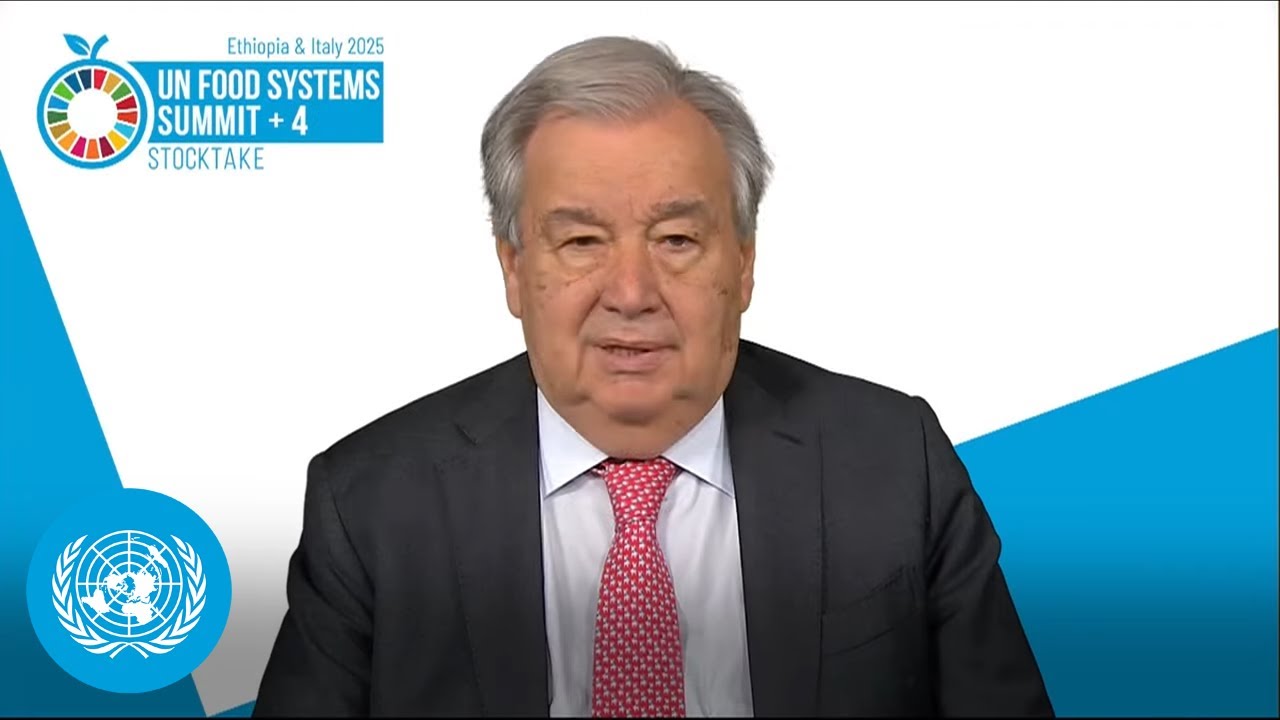
Video message by António Guterres, UN Secretary-General at the High-Level Opening “Harnessing a changing world for the future of sustainable food systems” – UN Food Systems Summit +4 Stocktake (UNFSS+4).
“Excellencies, Dear friends,
I thank the Government and people of Ethiopia and the Italian Government for co-hosting this important gathering.
I regret that circumstances have kept me from joining you in person.
Four years ago, the world came together for the first UN Food Systems Summit – anchored in the understanding that food systems are about more than food.
They are about health, nutrition, climate, decent work, justice – and the right to a better future.
Since then, we have seen progress.
Two-thirds of countries have integrated food systems transformation into national development plans.
Over 100 have aligned food strategies with climate and biodiversity goals.
And 155 countries are advancing efforts with National Convenors and strong engagement from businesses, civil society, Indigenous Peoples, youth and farmers.
The UN System, including through the UN Food Systems Coordination Hub, is their partner every step of the way.
Last year’s Pact for the Future reaffirmed our shared commitment to food systems that are inclusive, sustainable, equitable, resilient – and rooted in human rights.
But progress is not fast or fair enough.
Global hunger is rising.
Trade shocks are pushing food prices out of reach.
One-third of the world’s people cannot afford a healthy diet – while one-third of the world’s food is lost or wasted.
The hidden costs of our food systems – on health, nature, and human suffering – exceed $10 trillion a year.
That’s more than three times the GDP of the African continent.
This is not just a crisis of scarcity.
It is a crisis of justice, equity, and climate.
Nearly 40 percent of the global workforce is linked to food systems – yet many remain trapped in poverty.
Climate change is disrupting harvests, supply chains and humanitarian response.
Conflict continues to drive hunger – from Gaza to Sudan and beyond.
Hunger feeds further instability – and undermines peace.
We must never accept hunger as a weapon of war.
Dear friends,
We know what works.
Every dollar invested in nutrition can return up to twenty-three.
Sustainable food systems can advance all 17 Sustainable Development Goals.
And transformation is underway.
Governments are leading the way – integrating food systems into climate strategies, biodiversity frameworks, and national budgets.
They are empowering women and youth, scaling up nutritious school meals, and investing in agroecology.
Look no further than Ethiopia – where investments in local wheat production and climate-aligned food policy are reducing import dependence and creating jobs.
But governments cannot do it alone.
The private sector must play a vital role – from innovation and logistics to finance and investment.
We need responsible business practices aligned with the public good.
We need bold leadership – and enforceable guidelines for corporate accountability.
We must build on new partnerships like the Global Alliance against Hunger and Poverty and scale up action across sectors.
Looking ahead, I see three urgent priorities:
First, break down silos.
Food systems are everyone’s business.
We need integrated policies and a global framework that connects agriculture to people – their health, climate, trade, and finance.
We must also harness new technologies – including Artificial Intelligence – to boost production, reduce waste, and create decent jobs across the value chain.
Second, address power imbalances.
We must govern food systems fairly, tackle inequality and deliver on the right to food for all.
That means elevating the voices of women, youth, farmers, Indigenous Peoples, and local actors.
Third, unlock and connect finance at scale.
Transformation requires investment.
We need debt relief, greater access to concessional finance, and reform of the global financial system to give developing countries representation that reflects the realities of today’s global economy.
We need climate action – including at COP30 – to close the adaptation gap, align climate funding with food systems, and accelerate a just transition.
And above all, we need peace – so that investments can take root and farmers can look to the future with confidence.
Excellencies, Dear friends,
The future of food is the future of humanity.
Let us work together to build food systems that nourish every person, restore our planet, and grow prosperity from the ground up.
Thank you”.
For more Information or to watch the video on YouTube, click here.