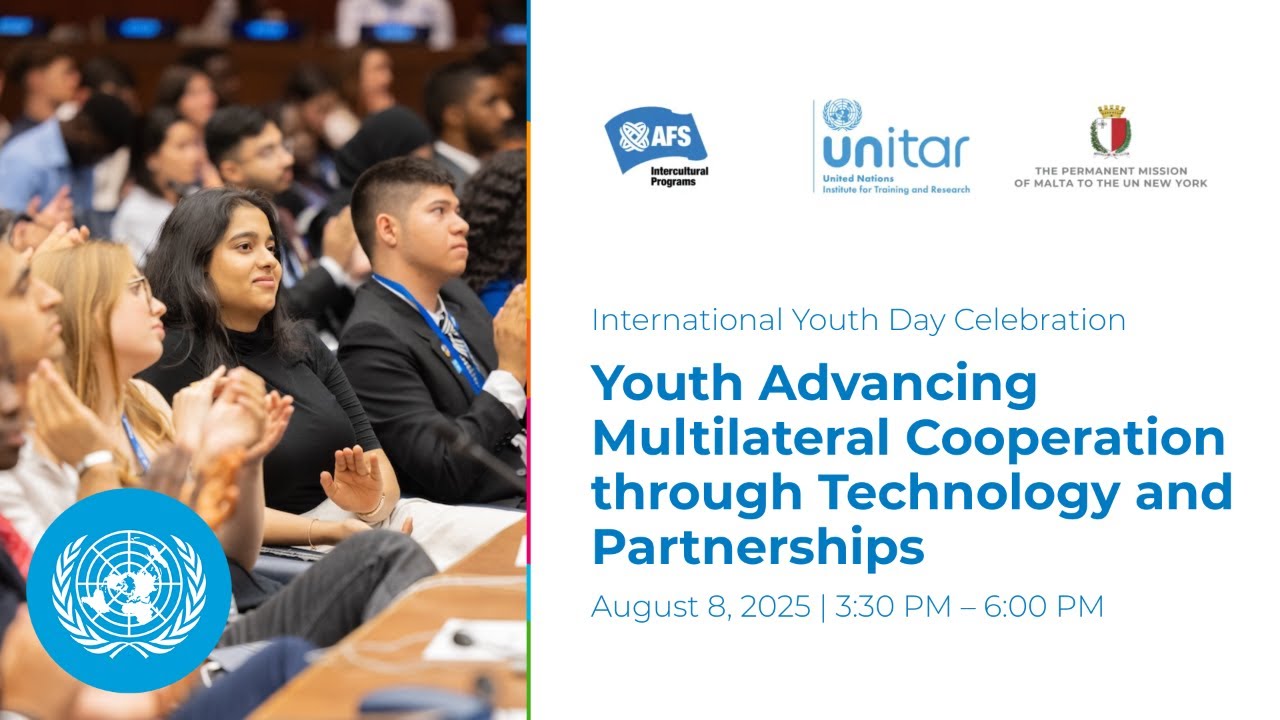
The theme for International Youth Day 2025, “Youth Advancing Multilateral Cooperation Through Technology and Partnerships,” highlights the vital role young people play in redefining multilateral diplomacy.
This year’s observance, organized in collaboration with UNITAR and AFS Intercultural Programs, provides a dynamic platform for young leaders, policymakers, diplomats, innovators, and civil society actors to engage in meaningful conversations on how technology and partnerships can strengthen global cooperation. Open to all through public registration, the event will encourage diverse participation, ensuring that voices from various backgrounds contribute to shaping a more connected and collaborative world.
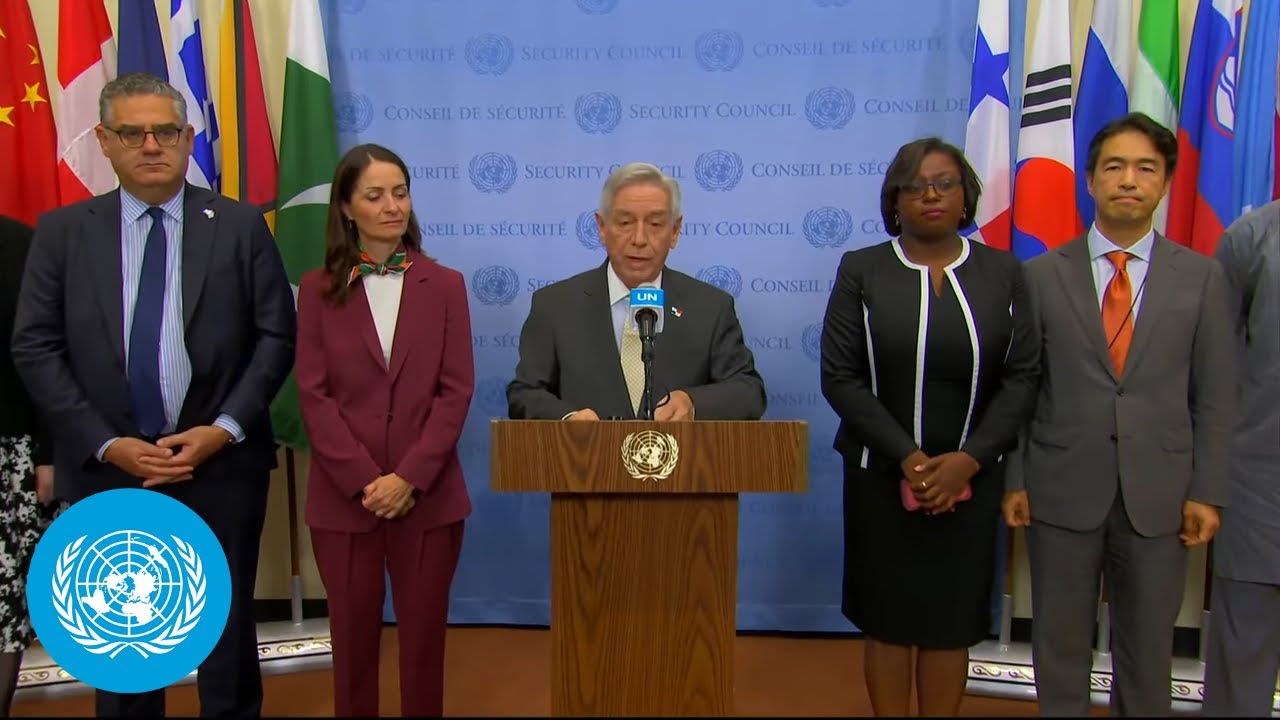
Joint press encounter by Security Council signatories of Shared Commitments on Women, Peace and Security (WPS), led by Ambassador Eloy Alfaro de Alba, Permanent Representative of Panama to the United Nations, and President of the Security Council President for the month of August, at the Security Council Stakeout.
Noon briefing by Farhan Haq, Deputy Spokesperson for the Secretary-General.
Highlights:
Hiroshima
Occupied Palestinian Territory
Security Council
Democratic Republic of the Congo
Somalia
Mozambique
Financial Contribution
HIROSHIMA
Izumi Nakamitsu, the High Representative for Disarmament, delivered a message on the Secretary-General’s behalf at the commemoration of the 80th year since the bombing of Hiroshima in Japan.
In his message, the Secretary-General said that on this 80th anniversary, we remember those who perished. We stand with the families who carry their memory. And we honour the brave hibakusha — the survivors — whose voices have become a moral force for peace.
He warned that today, the risk of nuclear conflict is growing. Trust is eroding. Geopolitical divisions are widening. And the very weapons that brought such devastation to Hiroshima and Nagasaki are once again being treated as tools of coercion.
Yet, the Secretary-General added, there are some signs of hope. Last year, the Japanese organization Nihon Hidankyo — which represents the survivors of the Nagasaki and Hiroshima bombings — was awarded the 2024 Nobel Peace Prize for its tireless work in raising awareness about this critical issue. And in the Pact for the Future, adopted last year, countries re-committed to a world free of nuclear weapons.
OCCUPIED PALESTINIAN TERRITORY
The UN humanitarian country team in the Occupied Palestinian Territory, which brings together UN agencies and NGOs working in that area, today called on Israeli authorities to rescind the requirement obliging international non-governmental organizations (NGOs) to share sensitive personal information about their Palestinian employees or face termination of their humanitarian operations in the Occupied Palestinian Territory.
Unless urgent action is taken, humanitarian organizations warn that most international NGO partners could be de-registered by 9 September or sooner – forcing them to withdraw all international staff and preventing them from providing critical, life-saving humanitarian assistance to Palestinians. This requirement is part of a set of new restrictive conditions for international NGOs which include potential consequences for public criticism of policies and practices of the Government of Israel.
Already, NGOs that are not registered under the new system are prohibited from sending any supplies to Gaza. This policy has already prevented the delivery of such aid as medicine, food, and hygiene items. There are more details in a press release.
Turning to the Gaza Strip, our colleagues at the Office for the Coordination of Humanitarian Affairs tell us that more people are being killed and injured, either along convoy routes or where they are staying. The situation is beyond catastrophic.
Hospitals are overstretched. Patients are lying on the floor or in the streets, suffering as beds, medical supplies and equipment are severely lacking.
Yesterday, emergency medical teams were denied entry into Gaza. The World Health Organization tells us that more than 100 health professionals, including surgeons and other specialized medical staff, have been barred from entry since March this year.
Yesterday, you heard that Israeli authorities allowed the entry of a limited number of trucks carrying commercial goods. While we are still following up to obtain more clarity on this, initial reports from our partners on the ground indicate that the items included rice, sugar and vegetable oil.
Sugar remains one of the most expensive items on the market. A two-ounce bag costs some $170. Eggs, poultry and meat have disappeared from the market. People rely on pulses and bread to survive, when and if available, which is far from being enough for the most vulnerable people.
The worsening market situation underscores the urgent need for the entry of humanitarian aid and commercial goods at scale – and consistently.
Starvation continues to happen, and today, the Ministry of Health reported five new malnutrition-related deaths in the past 24 hours, bringing the total to about almost 200 deaths, half of whom are children. Our colleagues tell us that “hunger and malnutrition have devastating impacts, including a heightened risk of illness and death.
Full Highlights: https://www.un.org/sg/en/content/ossg/noon-briefing-highlight?date%5Bvalue%5D%5Bdate%5D=06%20August%202025
“Hamas and other Palestinian armed groups continue to hold 50 hostages, 28 of whom are thought to be deceased, in captivity in horrific conditions,” the UN Assistant Secretary-General for Europe, Central Asia and the Americas, Miroslav Jenča, told the Security Council.
Briefing the Security Council today (Aug 05), Jenča said that released hostages had described “distressing accounts of deprivation, ill-treatment, and abuse,” while armed groups had circulated videos showing detainees clearly suffering and speaking under duress. “Since 7 October 2023, Hamas and other armed groups have circulated dozens of videos of hostages,” he said.
The meeting came days after the release of new footage by Hamas and Palestinian Islamic Jihad showing two Israeli hostages, Evyatar David and Rom Braslavski, visibly emaciated and with David being forced to dig his own grave.
Ilay David, the brother of Evyatar David, said, “My brother was a living skeleton. He had barely the strength to move or speak.” He added, “We were reminded just how much more cruel and inhumane Hamas and its sick partners are.”
David urged the international community to ensure humanitarian aid reaches the hostages. “While aid flows into Gaza to help the population, the hostages are being denied even the most basic necessities of life. They haven’t received the shred of humanitarian aid since they were captive. This is a flagrant violation of international law,” he said.
Russian Representative Dmitry Polyanskiy said it was “evident that Israel’s complete freedom of action would have been impossible without direct military support and international political cover from the United States. Illustrative in this regard was the joint U.S.-Israeli boycott of the high-level international conference in support of the two-state solution, held from July 28 to 30, as well as Washington’s futile attempts to dissuade its partners from participating in this representative forum.”
The US Representative Dorothy Shea said, “We must be clear that unproductive publicity stunts like last week’s Two State Solution Conference and unilateral announcements regarding recognition of a Palestinian state undercut the efforts of mediators and prolong the war.”
Palestinian Ambassador Riyad Mansour said, Israel is “demanding that the world take a stance against conditions of captivity of Israelis when it is holding two million people captive under its deadly siege, when 76 Palestinian prisoners have died under torture or starving or due to medical neglect in the last 20 months alone.”
Israeli Foreign Minister Gideon Saar said, “The Palestinians invented terrorism as a way to promote their means, and it includes all Palestinians fractions. And until this very day, the Palestinian Authority continue to pay salaries to terrorists and terrorist families accordingly to the crime the terrorists committed, and this is how they encourage terrorism until this very day.”
Speaking to reporters before the Security Council’s meeting Saar said certain countries had undermined negotiations by supporting Palestinian state recognition. “They gave Hamas free gifts and an incentive to continue this war. They directly assassinated the hostage deal and ceasefire,” he said. “Let me be clear, these countries prolonged the war.”
Comments to the media by Danny Danon, Permanent Representative of Israel to the United Nations and Gideon Saar, Foreign Minister of Israel on the situation in Palestine.
Noon briefing by Farhan Haq, Deputy Spokesperson for the Secretary-General.
Highlights:
Secretary – General / Conference on Landlocked Developing Countries
Plastic Pollution
Occupied Palestinian Territory
Sudan
Afghanistan / Refugees
India / UN Partnership For South – South Cooperation on the SDGS
PLASTIC POLLUTION
The second part of the fifth session of the Intergovernmental Negotiating Committee to develop an international legally binding instrument on plastic pollution, including in the marine environment, opened today in Geneva. The session, which will continue until 14 August, aims to finalize and approve the text of the agreement and forward it for consideration and adoption at a future Diplomatic Conference of Plenipotentiaries.
Noting that countries are negotiating a global plastics treaty to help beat plastic pollution, the Secretary-General emphasized that we need a fair deal that tackles the full life-cycle of plastics, reflects the International Court of Justice Advisory Opinion on Climate Change and supports a shift away from fossil fuels.
Inger Andersen, the Executive Director of the United Nations Environment Programme, pointed out that plastic pollution is already in nature, in our oceans and even in our bodies. And plastic leakage to the environment is predicted to grow 50 per cent by 2040, she added.
If we continue on the current trajectory, Ms. Andersen warned, the world will be drowning in plastic pollution – with massive consequences for planetary, economic and human health. She stressed that agreeing to a treaty text is the first step to beating plastic pollution for everyone, everywhere.
OCCUPIED PALESTINIAN TERRITORY
This afternoon at 3:00 pm, the Security Council will hold a briefing on the situation in the Middle East. Assistant Secretary-General Miroslav Jenča will brief, and the Council will also hear from Ilay David, the brother of a hostage who is being held in Gaza.
Meanwhile, the Office for the Coordination of Humanitarian Affairs (OCHA) says that people continue to struggle to survive in Gaza. With starvation on the rise, the volumes of supplies that are entering Gaza remain insufficient to meet people’s needs. In addition, the UN and our humanitarian partners continue to face many impediments preventing us from bringing in aid in sufficient quantities and distributing it to communities.
UN partners working on food assistance warn that massive food shortages continue to impact people’s chances for survival. As malnutrition levels are rising, children are more likely to have weakened immune systems, hindering their development and growth far into the future.
Last Thursday, 71 kitchens prepared and delivered more than 270,000 hot meals across Gaza. These included 10,000 meals delivered to health facilities, most of which are struggling to operate as mass casualties, widespread destruction and shortages of basic necessities continue to overwhelm the healthcare system.
The number of meals being provided is far below the minimum required to reach more than two million people in Gaza. We need an urgent scale-up of supplies, as well as an environment that allows humanitarians to reach people in need safely, rapidly and efficiently.
UN staff working in health say that some quantities of medicine have managed to reach Gaza in recent days. Medicine shortages place an additional strain on healthcare workers who continue to work under immense pressure and with very limited resources.
The World Health Organization (WHO) noted that the number of people diagnosed with Guillain-Barré syndrome – a rare, potentially deadly condition in which the body’s immune system attacks the nerves – has reached 46 cases and two deaths in July, with 38 per cent of the cases requiring intensive treatment.
This syndrome can be caused by a compromised immune system, poor nutrition and hygiene-related infections. WHO is working with the Health Ministry to continue surveillance of cases and address the gaps related to diagnostics and treatment.
Yesterday, the UN was able to bring three fuel tankers to Gaza City. The fuel was offloaded in a UNOPS-managed fuel station and will be used to power the most critical health, water and sanitation and emergency telecommunication facilities. OCHA once again stresses that much more fuel is needed daily to run emergency operations. Current levels of fuel are only allowing the UN and our partners to function at the bare minimum.
The UN and its partners working on water, sanitation and hygiene underscore that access to clean water remains limited, putting people’s health and well-being at risk. Ninety-six per cent of households across Gaza surveyed by our partners in July face moderate to severe challenges in accessing clean water – whether to drink, bathe their children or wash dishes.
Full Highlights: https://www.un.org/sg/en/content/noon-briefing-highlight?date%5Bvalue%5D%5Bdate%5D=05%20August%202025
Noon briefing by Farhan Haq, Deputy Spokesperson for the Secretary-General.
Highlights:
Secretary – General / Travel
Occupied Palestinian Territory
UNIFIL
Syria
Yemen
Sudan
Uganda
New Resident Coordinators
OCCUPIED PALESTINIAN TERRITORY
In response to questions about the videos of the Israeli hostages shown by Hamas, the Deputy Spokesperson said the Secretary-General was very shocked by this unacceptable violation of human dignity.
Turning to Gaza, the Office for the Coordination of Humanitarian Affairs says that many people reportedly continue to be killed and injured, including people seeking food along the UN convoy routes and militarized distribution points. Some 1,500 people have been reportedly killed since May.
Meanwhile, our colleagues continue to risk their lives to provide life-saving assistance. On Sunday, Israeli air strikes killed a health worker from the Palestine Red Crescent Society in Khan Younis.
Furthermore, yesterday, the Israeli military issued yet another displacement order in Gaza City, covering the neighborhood of Tufah. OCHA says that these orders continue to push people into overcrowded, unsafe areas with no shelters and essential supplies. OCHA reminds us that only 12 per cent of Gaza is outside the Israeli-militarized zone or areas affected by displacement orders. Our partners are still unable to respond to shelter needs due to zero stock, with no shelter supplies having entered Gaza since early March.
In the past few days, the UN and our partners have managed to collect wheat flour, ready-to-eat rations and hot meal commodities from the crossings; however, most of the cargo was offloaded by the hungry crowds before reaching its destinations.
While nutrition supplies have entered during the past week, including high-energy biscuits for pregnant and breastfeeding women and infant formula, and hygiene kits, UNICEF emphasized yesterday that this is still a fraction of what is needed and reminded that malnutrition among children in Gaza is reaching catastrophic levels.
The UN and our partners reiterate that a ceasefire is critically needed to reach all those in need and urge for the continued facilitation of a sustained, uninterrupted and scaled-up flow of aid, including commercial goods.
Regarding fuel, yesterday, the UN was able to collect about 200,000 litres from Kerem Shalom crossing; however, the limited quantities that have been entering Gaza since last week do not suffice to remedy the shortages.
For example, water, sanitation and hygiene operations continue to be affected by the lack of fuel. While some 70,000 litres of fuel are needed every day for emergency operations, only 29,000 litres have been received, which is far below the minimum quantity needed.
In a welcome development, Israeli authorities have approved an increase in the number of fuel tankers that are allowed to enter per week. We will update you once we have clarity.
As we enter the second week since the Israeli announcement of the tactical pause to allow safe passages for our convoys, colleagues tell us that realities on the ground remain largely the same. Aid that has entered remains by far insufficient for the starving population and our convoys continue to face impediments on their way to delivering aid.
Some missions inside Gaza take more than 18 hours to be completed. The teams are compelled to wait for more than 10 hours at a stretch on the roads, which are often dangerous, congested or impassable.
Yesterday, while seven out of 11 missions requiring coordination with Israeli authorities were facilitated, OCHA tells us that two others were impeded; one to collect health items was not fully accomplished; one was cancelled by the organizers.
Turning to the West Bank, OCHA tells us that violence by Israeli forces and settlers against Palestinian communities continues unabated. Settler violence incidents are on the rise. Last week, OCHA documented at least 24 Israeli settler attacks against Palestinians that resulted in casualties, property damage, or both. OCHA reiterates its call for the protection of civilians in the West Bank, including Jerusalem.
Full Highlights: https://www.un.org/sg/en/content/noon-briefing-highlight?date%5Bvalue%5D%5Bdate%5D=04%20August%202025
Secretary-General’s remarks at the Centre for Sustainable Development Goals for Central Asia and Afghanistan
————–
Distinguished President Tokayev and my dear friend,
Honourable Ministers,
Excellencies,
Ladies and Gentlemen,
It is a profound honour to join you today.
We have just signed the host country agreement for the United Nations Regional Centre for the Sustainable Development Goals for Central Asia and Afghanistan.
The Centre represents the opening of a new chapter – for the region and for our collective journey towards the Sustainable Development Goals.
It symbolizes the new era of cooperation in Central Asia – grounded in shared priorities and solutions.
And it holds great potential for showing how the strong bonds among the region’s leaders can translate into deeper economic integration, for the benefit of all people.
This is more essential than ever.
And I commend President Tokayev for his vision and his leadership in helping to shape this new Central Asia that will become more and more a fundamental power in our world order.
I thank Member States for supporting this initiative.
And I salute the people of Kazakhstan for their warm welcome.
Almaty is a fitting home for this Centre.
This is a city of history, resilience, and vision.
And Kazakhstan is an ideal and generous host.
This country has long served as a bridge between East and West, tradition and innovation.
The Centre has been mandated by the General Assembly, and I look forward to its operationalization – with terms of reference being finalized and leadership appointments to follow.
Soon, it will serve as a hub for regional collaboration … a laboratory for ideas … and a launchpad for action.
It will bring together governments, UN country teams, civil society, academia, the private sector, regional organizations, and financial institutions – to develop coordinated, country-led efforts;
And tackle some of the most pressing challenges of our time – from climate change and water scarcity to youth unemployment, gender inequality and digital exclusion.
Working together with our Resident Coordinators and Country Teams, it will contribute to accelerating progress toward the 2030 Agenda in Central Asia and Afghanistan – driven by the spirit of solidarity and shared responsibility that defines the United Nations.
Excellencies, dear friends,
We are only five years away from 2030 – but far from our destination.
The world is facing complex and interlinked challenges that threaten sustainable development.
Poverty is stalling. Hunger and malnutrition are plaguing societies. Inequalities are deepening. Conflicts continue to tear communities apart. And the climate crisis is accelerating.
In Central Asia, climate change is already draining water supplies, melting glaciers, and fuelling natural disasters.
The shrinking of the Aral Sea is a stark reminder of the region’s environmental vulnerability.
Rising trade tensions and global uncertainty compound these risks.
The region’s landlocked geography presents additional barriers – to trade, connectivity, financing, and access to global markets.
That is why I am especially pleased to be here on the eve of the Third United Nations Conference on Landlocked Developing Countries in Turkmenistan.
This Centre can become a vital pioneer in implementing the Programme of Action for Landlocked Developing Countries;
Today, we must say that Kazakhstan is no longer a landlocked country. Kazakhstan is a centre in the global trade system.
A centre in the global logistics, transportation and the telecommunication system with its corridors on roads, railways, fiber optics and transforming this country in really a bridge from East and West, North and South.
And the Centre can help ensure that the aspirations of landlocked nations are not constrained by geography – but can empower by cooperation and regional solutions.
It will build on the region’s greatest asset – its people.
Young people, women, entrepreneurs, and civil society – these are the true engines of progress, driving the innovation and resilience needed to leave no one behind.
The Centre will support data-driven policy, spark innovation, and amplify the voices of those too often unheard.
And nowhere is that cooperation more urgent than in our support to Afghanistan.
The people of Afghanistan continue to face immense hardship – from entrenched poverty and mass displacement to earthquakes, climate shocks, and a fragile humanitarian landscape.
…
Full Statement: https://www.un.org/sg/en/content/sg/statement/2025-08-03/secretary-generals-remarks-the-centre-for-sustainable-development-goals-for-central-asia-and-afghanistan-delivered
Press Conference by Ted Chaiban, Deputy Executive Director for Humanitarian Action and Supply Operations of the United Nations Children’s Fund (UNICEF), on his recent travel to the Middle East.
UNICEF senior official Ted Chaiban said, “One in three people in Gaza are going days without food,” warning that “we are at a crossroads. The choices made now will determine whether tens of thousands of children live or die.”
Ted Chaiban is the Deputy Executive Director of UNICEF’s Humanitarian Action and Supply Operations. He briefed reporters today (01 Aug) in New York after returning from a five-day mission to Israel, Gaza and the West Bank, including East Jerusalem.
Chaiban highlighted, “Gaza now faces a grave risk of famine,” adding that “more than 320,000 young children are at risk of acute malnutrition.”
The UNICEF humanitarian also said that there has been some easing of humanitarian access after the pauses announced by Israel, adding that the Agency has over 1,500 trucks of life-saving supplies ready across corridors in Egypt, Jordan, Ashdod, and Turkey.
“Some have begun to move, and we have delivered in the last couple of days 33 trucks of life-saving infant formula, High Energy Biscuits and hygiene kits,” he explained.
This is still a fraction of what is needed, Chaiban said, explaining that a big part of his mission has been advocacy and engagement with the Israeli authorities in Jerusalem and Tel Aviv.
He said, “We pressed for a review of their military rules of engagement to protect civilians and children. Children should not be getting killed waiting in line at a nutrition centre or collecting water, and people should not be so desperate as to have to rush a convoy for food. We called for more humanitarian aid and commercial traffic to come in – moving closer towards 500 trucks a day – to stabilize the situation and reduce the desperation of the population and also the looting and, what we call it self-distribution, when the population goes after a convoy, and also looting, when armed groups go after it because the price of food is so high.”
On getting the aid to the people, Chaiban said, “We know what must be done and what can be done. The UN and NGOs that form the humanitarian community can address this, along with commercial traffic, if the measures are in place to allow access and eventually have enough goods in the Strip that some of the issues that are there with law and order abate.”
Asked about airdropping aid, the UNICEF official said, “Airdrops cannot replace the volume and the scale that convoys by road can achieve.”
He continued, “what’s needed is simply not feasible in terms of volume, in terms of access through airdrops. And so try every modality, but what’s clearly needed is to move back towards a volume of around 500 trucks a day, through all routes and that includes both humanitarian aid and commercial as I have said.”
Chaiban also said that for children who have access to ready to use therapeutic food, whose mother also has access to specialized foods, they can physically recover relatively quickly with sustained food, however, the emotional well-being, the risk of stunting the mental health of the child will “get worse and worse the longer the child is in the situation that it’s in.”
The Third UN Conference on Landlocked Developing Countries opens an opportunity to explore meaningful partnerships to unlock the potential of landlocked developing countries.
Landlocked Developing Countries (LLDCs), lacking direct sea access, face hurdles in trade, connectivity, and development. Without coastal ports, they rely on transit nations, causing higher trade costs and delays. Despite challenges, LLDCs host vibrant communities with untapped potential.
The Third UN Conference on LLDCs offers a chance to explore solutions and forge partnerships, addressing challenges and unlocking their full potential for a more equitable and prosperous future.
Press conference by Eloy Alfaro de Alba, President of the Security Council for the month of August (Panama), on the programme of work for the month of August 2025.
On the recent developments in Ukraine, UN senior official Miroslav Jenča said, “Diplomacy, not fighting, needs to escalate in the coming days and weeks.”
Jenča told Council in New York today (01 Aug) that overnight, between 30 and 31 July, another large-scale Russian missile and drone attack hit Kyiv. At least 31 people, including five children, were reportedly killed. 159 people, including at least 16 children, were reportedly injured. The number of children injured in this attack was the highest in a single night in the city since the beginning of the Russian Federation’s full-scale invasion.
The Assistant Secretary-General also told Council that there are reports of civilian casualties, including civilian deaths in the Belgorod, Bryansk, Kursk and Rostov regions of the Russian Federation. The world body is not in a position to verify these reports but remains concerned about the increasing impact of the reported Ukrainian strikes on the civilian population in the Russian Federation.
Jenča reiterated that attacks on civilians and civilian infrastructure are prohibited under international law and must stop immediately – wherever they occur.
The senior UN official also highlighted “Ukrainian people have endured nearly three and a half years of unimaginable horrors, death, devastation and destruction. They urgently need relief from this nightmare.”
He reiterated the urgent call for “an immediate, unconditional, and complete ceasefire to pave the way towards a just, lasting and comprehensive peace.”
“A peace that is in line with the Charter of the United Nations, international law, and relevant UN resolutions in full respect of the sovereignty, independence and territorial integrity of Ukraine, within its internationally recognized borders,” the senior UN official added.
Jenča said, “Diplomacy, not fighting, needs to escalate in the coming days and weeks. Diplomacy that leads to real, tangible, verifiable and lasting results that would be felt by the long-suffering people on the ground.”
“The United Nations remains ready to support all meaningful efforts to this end,” he concluded.
For his part, Russian Ambassador Dmitry Polyanskiy said, “the expired princeling in Kyiv is not interested in easing the plight and suffering of his civilians, but rather in presenting such situations provoked by him presenting them as intentional Russian strikes.”
“His only goal here is to save his own height and convince his sponsors to continue financial and military support to his agonizing, dictatorial and corrupted regime,” Ambassador Polyanskiy continued.
He added, “The abuse of the Security Council meetings so as to shift the responsibility for the death of his own citizens, is a favorite trick of Ukraine.”
The Russian Ambassador concluded by underscoring once again that his government is not against discussing the Ukrainian crisis in the Council. “We’re against making the tragedy of the Ukrainians who became hostages of the Zelenskyy regime, and his maniacal will to sacrifice them on the altar of geopolitical interests that is exploited in the Council for political reasons,” he said.
“ It’s disrespectful and indifferent to the suffering of tens of thousands of people who are dying and suffering in other areas of the world, and Western members of Security Council are in no hurry to ask for meetings on that,” Ambassador Polyanskiy said.
Khrystyna Hayovyshyn, Chargée d’Affaires of Ukraine to the United Nations also spoke at the Council.
She said, “Once again, the world witnessed Russia’s response to our desire for peace, shared with the United States and Europe: new killings, more destroyed homes.”
“It is a deliberate campaign to terrorize civilians and destroy any notion of normal life in Ukraine,” the Ukrainian diplomat said.
She continued, This effort is propped up by Iran and the DPRK, in blatant defiance of numerous Security Council resolutions. These regimes supply Moscow with drones, missiles, and ammunition, while Chinese companies continue to provide dual-use goods and equipment – contributions that further fuel Russia’s ability to wage war and deepen the suffering inflicted on the Ukrainian people.”
Chargée d’Affaires Hayovyshyn pointed out, “Russia awaits the international law to be defeated, they believe that the world will look away and that justice will be avoided.”
“Don’t push the horses. This will not be the case,” she said, adding that “Russian illusions will shatter against the unbreakable resiliency of the Ukrainian people. Russian illusions will shatter against the unyielding will of the international community. Because we stand united in defense of justice and freedom.”
United Nations Secretary-General António Guterres briefed Member States during an informal meeting of the General Assembly on the next phase of the UN80 Initiative, highlighting steps needed to streamline how the organization implements the thousands of mandates that guide its work.
“As we all know, these problems have grown worse. We must learn from what went wrong. We must do better. And I believe we can,” Guterres said today (Aug 01), referring to inefficiencies in the mandate system.
The briefing followed the circulation of a report on 31 July 2025, presenting findings from Workstream 2 of the UN80 Initiative, a Mandate Implementation Review, which examines the structures, processes, and services related to mandate creation, delivery, and review. The report does not assess the content or merit of any mandates themselves.
Launched in March 2025, the UN80 Initiative aims to enhance the United Nations’ efficiency, effectiveness, and responsiveness to global challenges in the lead-up to the Organization’s 80th anniversary. The initiative focuses on three reform tracks: internal efficiency, mandate implementation review, and structural and programmatic reforms.
Since 1946, the UN’s three main organs, the General Assembly, Security Council, and Economic and Social Council, along with their subsidiary bodies, have issued mandates through over 40,000 resolutions, decisions, and presidential statements. These mandates define the UN’s activities and hold the Secretariat accountable, yet their sheer volume and complexity have created a “vast – and often opaque” landscape, the Secretary-General said.
“There is no easy way to know what already exists, or what has been adopted across different bodies,” he warned. “The risks of duplication and overlap are clear.”
Guterres emphasized that mandates are the responsibility of Member States, “They are the expression of your will. And they are the sole property and responsibility of Member States. The vital task of creating, reviewing or retiring them lies with you – and you alone. Our role is to implement them – fully, faithfully, and efficiently.” He called for reforms that would include “fewer meetings, fewer reports,” and more tailored, transparent systems for monitoring and reporting on mandate implementation.
Letter by the President of the General Assembly:
https://www.un.org/pga/79/2025/07/18/letter-from-the-president-of-the-general-assembly-on-the-briefing-on-the-report-of-the-secretary-general-on-the-un80-initiative/
Noon briefing by Farhan Haq, Deputy Spokesperson for the Secretary-General.
Highlights:
UN80
Trip Announcement
Deputy Secretary-General/ Travel
Occupied Palestinian Territory
Haiti
Haiti – Humanitarian
Security Council/Afternoon
World Breastfeeding Week
Briefings Today
UN80
The Secretary-General this morning provided an update to Member States on his UN80 initiative, focusing on his report, issued yesterday, on what is known as “workstream two,” which deals with the implementation of mandates received from Member States. Mandates are the sole property of Member States, he affirmed.
Mr. Guterres said that the problems with mandates are well known: Burdensome processes. Overlap. Duplicative structures. And a growing gap between mandates and resources. And he told the Member States that the review of mandates is not about questioning their decisions but about implementing them — more effectively, more efficiently, and with greater impact. Mandates are not ends in themselves, the Secretary-General said; they are tools to deliver real results, in real lives, in the real world.
He said that today, there are more than 40,000 resolutions and decisions on the books – and counting. The risks of duplication and overlap are clear.
Meanwhile, since 2020, the average word count of General Assembly resolutions has increased by 55 per cent. ECOSOC texts have grown by 95 per cent. And Security Council resolutions are now three times longer than they were 30 years ago.
The Secretary-General added that we cannot expect far greater impact without the means to deliver. By spreading our capacities so thin, we risk becoming more focused on process than on results.
That is why, he said, the report puts for their consideration a possible shift: Toward shorter, clearer, and more focused mandates.
TRIP ANNOUNCEMENT
The Secretary-General will travel to Central Asia this weekend. On Sunday, the Secretary-General and the President of the Republic of Kazakhstan, Kassym Jomart Tokayev, will witness the signing of the Host Country Agreement for the UN Regional Centre for the Sustainable Development Goals for Central Asia and Afghanistan, which has been formalized by the General Assembly. The signatories will be Murat Nurtleu, the Deputy Prime Minister and Minister of Foreign Affairs of Kazakhstan, and Li Junhua, the Under-Secretary-General for Economic and Social Affairs.
From Kazakhstan, the Secretary-General will travel to Awaza in Turkmenistan, to attend the Third UN Conference on Landlocked Developing Countries. He will reaffirm the need to help the Landlocked Developing Countries overcome physical barriers and connect to global markets, including by leveraging Artificial Intelligence to strengthen early warning systems.
While in Turkmenistan, the Secretary-General is expected to have bilateral meetings with the host country leaders, as well as leaders and officials attending the conference.
For full Highlights:
https://www.un.org/sg/en/content/noon-briefing-highlight?date%5Bvalue%5D%5Bdate%5D=01%20August%202025
Cookies are used on our website to make your use as comfortable as possible. These so-called essential cookies are stored in your browser because they are essential for the basic functions of the website.
We also use third-party cookies for online advertising on our sites. These cookies are only stored in your browser with your consent. By clicking here you agree to the use of these additional cookies or you can reject them:
This website uses cookies to improve your experience while you navigate through the website. Out of these, the cookies that are categorized as necessary are stored on your browser as they are essential for the working of basic functionalities of the website. We also use third-party cookies that help us analyze and understand how you use this website. These cookies will be stored in your browser only with your consent. You also have the option to opt-out of these cookies. But opting out of some of these cookies may affect your browsing experience.
Necessary cookies are absolutely essential for the website to function properly. These cookies ensure basic functionalities and security features of the website, anonymously.
Cookie
Duration
Description
cookielawinfo-checkbox-analytics
11 months
This cookie is set by GDPR Cookie Consent plugin. The cookie is used to store the user consent for the cookies in the category "Analytics".
cookielawinfo-checkbox-functional
11 months
The cookie is set by GDPR cookie consent to record the user consent for the cookies in the category "Functional".
cookielawinfo-checkbox-necessary
11 months
This cookie is set by GDPR Cookie Consent plugin. The cookies is used to store the user consent for the cookies in the category "Necessary".
cookielawinfo-checkbox-others
11 months
This cookie is set by GDPR Cookie Consent plugin. The cookie is used to store the user consent for the cookies in the category "Other.
cookielawinfo-checkbox-performance
11 months
This cookie is set by GDPR Cookie Consent plugin. The cookie is used to store the user consent for the cookies in the category "Performance".
viewed_cookie_policy
11 months
The cookie is set by the GDPR Cookie Consent plugin and is used to store whether or not user has consented to the use of cookies. It does not store any personal data.
Functional cookies help to perform certain functionalities like sharing the content of the website on social media platforms, collect feedbacks, and other third-party features.
Performance cookies are used to understand and analyze the key performance indexes of the website which helps in delivering a better user experience for the visitors.
Analytical cookies are used to understand how visitors interact with the website. These cookies help provide information on metrics the number of visitors, bounce rate, traffic source, etc.
Advertisement cookies are used to provide visitors with relevant ads and marketing campaigns. These cookies track visitors across websites and collect information to provide customized ads.